
Home » The Digital SAT: What’s Tested, How It’s Scored, and How to Improve Your Score » SAT Prep Options: How Many Hours You Need, What Each One Costs » How to Choose SAT Prep: Classes, Tutoring, Self-Study, and Free Options
By Glyn Caddell, BSME · Author of Digital SAT Math Secrets · Tutoring since 2008 — Published September 23, 2026
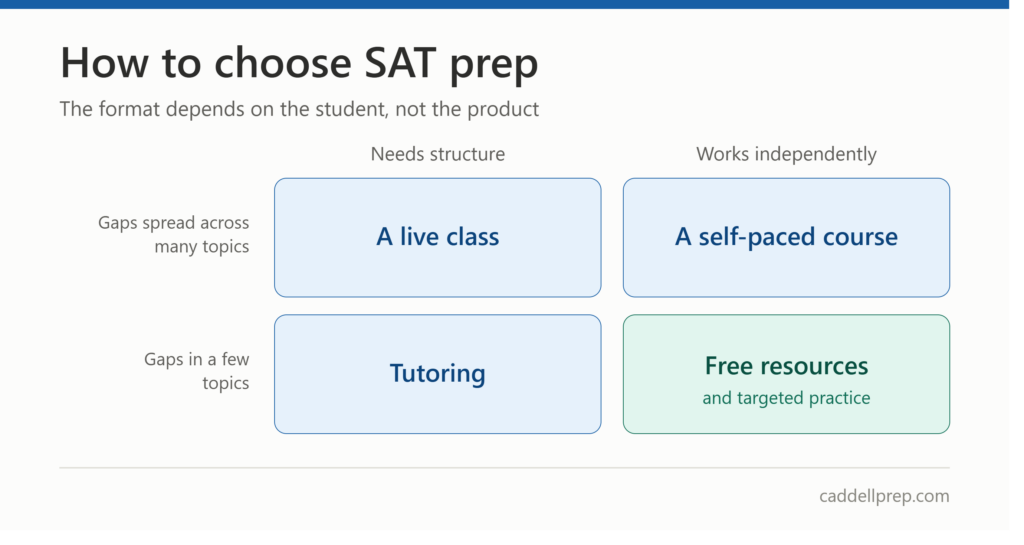
There are four ways to prepare for the SAT. Free resources, a self-paced course, a live class, and one-on-one tutoring.
Which one a student needs has very little to do with the options themselves. It depends on the student, and three questions settle it.
A note about who’s telling you this. Caddell Prep sells a self-paced course, prep classes, and tutoring. That’s three of the four options on this page, and you should read it knowing that.
Here’s the standard we’re holding to. The advice below is what we’d give if we sold nothing, and for some students the right answer is free preparation. If you get to the end and we never said that plainly, we didn’t do our job.
Table of Contents
- What Are the Four Ways to Prepare?
- Which Three Questions Decide the Format?
- Which Format Fits Which Student?
- How Do You Answer the First Two Questions?
- What Should You Read Next?
What Are the Four Ways to Prepare?
They differ on two things that matter more than price: who decides what gets studied, and what keeps the student on schedule.
| Format | Who picks the topics | What keeps you on schedule | How much of the test it covers | Cost |
|---|---|---|---|---|
| Free resources | You do | Nothing | Whatever you choose to cover | Free |
| Self-paced course | The course | You do | All of it | Low |
| Live class | The instructor | The class schedule | All of it | Moderate |
| Tutoring | The tutor, from your diagnostic | The appointment | Only what you need | Highest |
Free resources. Khan Academy offers free Digital SAT lessons and practice, and the College Board’s Bluebook app includes free full-length practice tests in the real test format. Both are good. What they don’t do is tell you which topics to work on first, and nobody expects you on Wednesday.
A self-paced course. Structured lessons and practice covering the whole test, worked through on the student’s own schedule. The course decides the order. The student decides when.
A live class. A fixed schedule, an instructor, and other students. It covers the whole test and the schedule is what keeps a student moving.
Tutoring. One-on-one, built around a specific student’s gaps. It’s the only format where the hours go exclusively to what that student needs, and it’s the most expensive per hour for exactly that reason.
None of this tells you which one to pick. That depends on three things about the student.
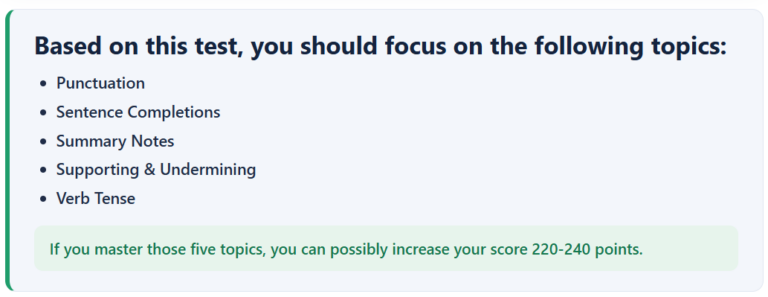
Want to Know What 5 Topics Will Improve Your SAT Score the Most?
Sample Feedback from our Diagnostic Test:
Which Three Questions Decide the Format?
How big is the gap? The distance between the current score and the target score sets how many hours are needed. Based on the students we’ve worked with since 2008, a 70 to 130 point improvement takes approximately 40 hours of effective studying, and a 130 to 250 point improvement takes approximately 80.
How many topics is the gap spread across? There are 32 topics on the Digital SAT. A student losing points across fifteen of them and a student losing points in four of them need different things, even if their scores are identical.
Will the student work without someone expecting him? This is the question families answer too optimistically, and it’s the one that most often decides whether a plan survives past week three. A parent normally knows the real answer. It’s worth answering honestly rather than hopefully.
The last two questions produce four combinations, and each has a format that fits it.
Which Format Fits Which Student?
| Needs structure | Works independently | |
|---|---|---|
| Gaps spread across many topics | A live class | A self-paced course |
| Gaps in a few topics | Tutoring | Free resources and targeted practice |
Many topics, needs structure: a live class. The class covers the whole test, so the breadth is handled, and the schedule does the work of getting the student to show up. This is the most common situation and it’s why classes exist.
A few topics, needs structure: tutoring. A student with four specific gaps who sits through a class spends most of it reviewing material he can already do. Tutoring puts every hour on the gaps, and the appointment supplies the structure.
Many topics, works independently: a self-paced course. Full coverage without a fixed schedule. This suits a student whose schedule can’t take fixed class times but who will still open the material on a Tuesday night.
A few topics, works independently: free resources and targeted practice. For a student with a small number of specific gaps who will do the work without anyone checking, free preparation is the right answer. Paying for a class buys coverage of topics he can already handle, and paying for a course buys structure he doesn’t need.
We mean that. It’s the fourth cell of the table and it’s real.
Once the format is decided, the size of the gap decides how much of it a student needs. Forty hours and eighty hours look very different spread across four weeks or six months, and that’s covered in how to build an SAT study plan.
Every answer above depends on knowing where the points are going.
How Do You Answer the First Two Questions?
A practice test with a proper assessment answers both at once.
A free diagnostic SAT gives an accurate score based on College Board scoring, which tells you the size of the gap. It also gives a ranked list of which of the 32 topics are costing the most points, which tells you whether the gap is concentrated in a few topics or spread across many.
That’s questions one and two answered in about three hours, before anyone spends money.
Question three is different. No test answers it, and a student’s own estimate of it is normally generous. The honest version comes from looking at how the last few months of schoolwork actually went.
With the three answers, the next step depends on which format they point to.
What Should You Read Next?
The table above gives a direction. The three comparisons below cover the decisions families most often get stuck on: whether a paid option beats the free one, whether a student can realistically self-study, and how to choose between a tutor and a class.
Caddell Prep vs Khan Academy
Khan Academy is the free option every family considers, and it’s genuinely good. Any honest comparison starts there.
What a paid course adds is the prioritized topic list and a video explanation for every question. Whether that’s worth paying for depends on how disciplined the student is and how much of the test he needs to cover.
See Caddell Prep vs Khan Academy for the full comparison.
When Does Self-Study Work?
Self-study works for more students than test prep companies admit and fewer than students believe.
The deeper version of the fourth cell above covers the conditions that make it work, and the warning signs that it isn’t working, which normally show up in week two or three.
SAT Tutor or Prep Class?
This is the comparison families get stuck on most often, because both are paid options and the price difference is large.
The answer comes down to how spread out the gaps are and what the starting score is. A student who is behind across the board is normally better served by a class, at a much lower cost per hour.
What Does Each Format Cost?
Free resources cost nothing. The paid formats vary widely, and the useful comparison is cost per hour of instruction rather than the headline price, since 24 hours in a class and 24 hours of tutoring are different products at different prices.
For Caddell Prep’s own options and what each costs, see SAT prep options. For what SAT preparation costs across the market, including other providers, see the cost of SAT prep.
What If the Answer Changes Partway Through?
It often does, and formats combine more easily than families expect.
A student can start with free resources and add tutoring for the two topics that won’t move. A student can take a class and add tutoring afterward for whatever the class didn’t close. A student who buys a self-paced course and stops opening it has learned something useful about question three.
A practice test every few weeks is what tells you the answer has changed. If the score has stopped moving, the format is normally the reason.

Glyn Caddell
Glyn Caddell holds a BS in Mechanical Engineering from NJIT and has been tutoring New York City students since 2008. He founded Caddell Prep in 2012 and is the author of Digital SAT Math Secrets: Lessons & Tricks to Quickly Improve to a Perfect 800 on the Math Test, which contains over 900 practice problems and is used in Caddell Prep’s SAT math classes. He is founding president of the Staten Island Technical High School alumni association and teaches every lesson on this site personally.
Finally, an SAT course that students actually understand
Every question has a video explanation. Not most — every one.
The on-demand Digital SAT course covers all 17 math topics and 15 reading and writing topics, with 5 full-length practice tests and a 100-point score increase guarantee. Keep access for the rest of high school. No subscription.
Want to Know What 5 Topics Will Improve Your SAT Score the Most?
Sample Feedback from our Diagnostic Test: