

Exponential Growth/Decay questions on the Digital SAT test students’ knowledge of the exponential function 
These problems involve quantities that increase or decrease by the same percentage rate over equal time intervals.
The general formula is:
Where:
= initial amount
= rate of growth/decay (as a decimal)
= number of time periods
= growth
= decay
Here are some examples of Exponential Growth/Decay questions from the Digital SAT.
- For the function
, the value of
decreases by 45% for every increase in the value of
by 1. If
, which equation defines
- Given an exponential function, which of the following is the best interpretation of the
-intercept of the graph in this context?
- How much time, in minutes, does it take for the number of bacteria in the population to double?
- Given an exponential function, the population is predicted to increase by 4% every
months. What is the value of
Exponential growth is typically caused by growth that is based on a percentage or ratio.
To better understand the difference, compare exponential growth to linear growth.
Suppose you deposited $100 in the bank and received $10 every year from the bank for keeping your money there. The amount of money in your account would increase linear because it would increase at a constant rate: $10/year.
The amount of money in the account could be represented by the function 
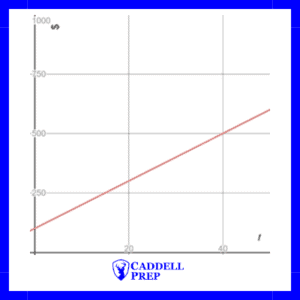
Suppose you deposited $100 in a different bank and received 5% interest each year. The first year you would only receive $5 because 5% of $100 is $5. However, the next year you would receive $5.25 because you would get 5% of $105. The following year, you would receive 5% of $110.25, which is $5.51. The amount of money you receive each year is bigger than the previous year’s amount. This is exponential growth.
More precisely, since it is growing by 5%, each year will be 105% of the previous year, so each year will be a multiple of 1.05 of the previous year.
The amount of money in the account could be represented by the function 
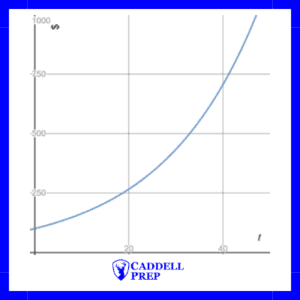
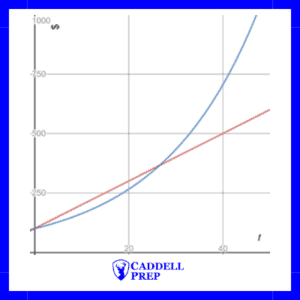
The function

where 
Since we add the rate to 1, we end up with growth.
Example:
A population of 500 rabbits increases by 6% each year. How many rabbits after 3 years?
Explanation:

Evaluating gives

So about 596 rabbits.
Like exponential growth, exponential decay is typically based on a percentage or ratio. However, since it is decaying (decreasing) the ratio is less than one.
Let’s look at an example. Suppose the population of an organism was initially 10,000 and the population decreases by 5% each year. The first year, the population would decrease by 5% of 10,000, which is 500. The population next year would start at 9,500 and would decrease by 5% again that year, so it would decrease by 475. Each year, the population decreases by 5%.
More precisely, since it is decreasing by 5%, each year will be 95% of the previous year, so each year will be a multiple of 0.95 of the previous year.
The population of the organisms could be represented by the function 
Here is a graph of 
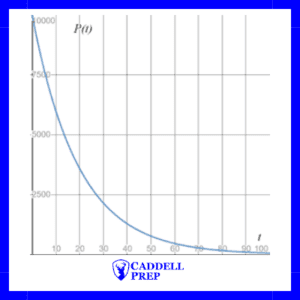
The function
where

Since we subtract the rate from 1, we end up with decay.
Example:
A car worth $20,000 depreciates 15% each year. What’s its value after 2 years?
Explanation:

Evaluating gives

So the car is worth $14,450 after 2 years.
- Doubling: If a population doubles every certain time period,

- Half-life: If something halves every certain time period,
.

If the percent increase or decrease is annual, then the exponent has to represent the number of years.
If the question wants you to use a variable that represents a time interval other than years, you have to convert it to years.
For example, a question may ask to represent the formula in terms of 
To convert months to years, you have to divide by 12 (12 months equal one year, and 36 months equal three years). Therefore, the exponent should be 
- Always convert the percent to a decimal (15% → 0.15).
- Make sure
- For questions involving doubling or halving each year, it may be easier to just write out the numbers each year than use a formula.
- Watch out for successive changes: you multiply, not add.
- If you struggle to understand how increasing or decreasing by a percentage works, review the percent lesson.
 models the population of a city years after a census was taken. Which function best models the population of the city months after the census was taken?


 represents years and represents months, months is equivalent to year. Substitute for in the original function:
Four common mistakes students make when answering exponential growth/decay questions include using the actual year for
A common mistake for exponential growth/decay questions is using the actual year for
For example, if the question states a federal park had 500 buffalo in 2002, but the population declines by 5% each year, and it asked to find the population in 2030, a mistake would be to use 2030 for
A common mistake on the Digital SAT for exponential growth/decay questions is inputting the percent as a decimal, 

For example, if a population increases by 20% each year, the formula should resemble


A common mistake is to not account for the 1 and only enter

A common mistake is using the wrong conversion for the exponent. The exponent should represent the number of time intervals in units that match the units specified for the compounding change. For example, if the amount decays by 10% per year, then the exponent should represent the number of years. Likewise, if the amount decays 10% each month, then the exponent should represent the number of months.
A common type of question that shows up on the Digital SAT involves a percent change per year, but the formula has to be in terms of 
The general formula is 
For exponential growth, the percentage is added to 1.

For exponential decay, the percentage is subtracted from 1.