

Here are some examples of Ratios & Proportions questions from the Digital SAT.
- At this speed, what is the time, in seconds, that it would take for the object to travel 108 centimeters?
- Which equation represents the total amount of paint
, in gallons, needed to paint the walls of the room twice?
- What is the area, in square miles, of this park?
- If the width of the rectangular region increases by 7 units, how must the length change to maintain this ratio?
- What is this rate, in miles per minute squared, rounded to the nearest tenth?
- The area of circle B is how many times the area of circle A?
An example of a rate is 25 miles/hr, which means the object will move 25 miles for every hour that passes.
An example of a ratio is 2 eggs:3 ounces of flour, which means the recipe calls for 2 eggs for every 3 ounces of flour used.
A statement that 2 rates or ratios are equal is a proportion.
For example, this is a proportion:

We can check if the proportion is correct by cross-multiplying
If we cross multiply, we get

which simplifies to

This proves that the proportion is correct.
When setting up a proportion, always write down how you will set it up.
For example, if we know that someone reads 13 pages every 4 minutes, we can find out how many pages he would read in 22 minutes.
Write down how it would be set up first.

Then insert the values.

Use cross-multiplication to solve
becomes

Simplify to get

Divide both sides by 4 to get

That means based on the rate, the person would read 71.5 pages in 22 minutes.
A common type of proportion question on the SAT is a word problem in which a ratio is given. However, instead of giving you a value of one of the elements in the ratio, the question gives you the total of the elements in the ratio.
To solve for values when a ratio and a total is given, multiple each number in the ratio by x and then create an equation in which they all add up to the total. Then solve for x, and use that value of x to determine the other values.
Example
The ratio of boys to girls in a class is 2:3. If there are 45 students, how many boys are there?
Explanation & Solution
We know that the ratio of boys to girls is 
What’s important is that whatever we multiply 2 by (for boys) we have to multiply 3 by (for girls). We can represent the number of boys as 

We know that
(# of boys) + (# of girls) = (total # of students)
We can write the equation as

Combine like terms to get

divide both sides by 5

This is not the answer. The question asks for the number of boys.
Number of boys is 
A way the SAT tests your knowledge of proportions is to mix up units on proportion questions.
Make sure to correct the units if they are different, before setting up the proportion.
Example
Tammy can read 10 pages in 4 minutes. How many pages can she read in 2 hours?
Explanation & Solution
Let’s set up the proportion as

Now, let’s set it up.
If we write

This would be incorrect because in the denominator on the left the 4 is in minutes and in the denominator on the right the 2 is in hours. The units don’t match up.
Let’s rewrite the 2 hours as 120 minutes, so both sides are using minutes.

Now, we can cross-multiply

Simplify

Divide both sides by 4

On the SAT, you may be asked to compare the results of a formula when certain values are changed to an original value in the form of a ratio.
When given a formula, we can determine how one value will be affected by altering other values.
For example,
The weight of an object, 


If the mass,
Just like when we solve equations, whatever we do to one side of the equation, we have to do to the other side of the equation.
Tip to Find the Multiple
Sometimes, it is not obvious how doubling/tripling/halving one variable will impact the overall value. It’s especially not obvious when one of the variables is raised to an exponent.
A trick to find the answer is to first substitute 1 in for all of the variables and evaluate the formula. Make a note of the value.
Now, you are going to find the new value with the variables that are supposed to be doubled/halved/tripled/etc.
Since all of the initial variables were all 1, any multiple done to a variable will just make it that number:
- Substitute in a 2 for a variable that is supposed to be doubled.
- Substitute in a 1/2 for a variable that is supposed to be halved.
- Substitute in a 3 for a variable that is supposed to be tripled.
- Substitute in a 1/3 for a variable that is supposed to be divided by 3
- & so on.
After substituting in the new values for the variables and using 1 for variables that don’t change, calculate the new value.
Divide the new value by the original value to find the multiple.
Example
The elastic potential energy in a spring 


A)
B)
C)
D)
Explanation
The answer is C.
Start with substituting 1 in for all variables
becomes

evaluate to get

Now, find the value of
Substitute 2 in for 

evaluate to get

Therefore the value of 
You can check by dividing the new value by the original value

Similar figures and shapes have proportionate side lengths.
A useful way to write down how we are setting up a proportion regarding geometric shapes is:

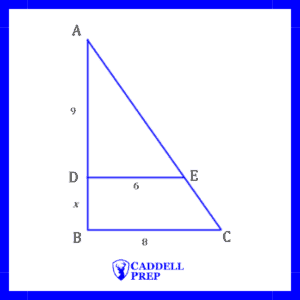
When dealing with proportionate shapes, make sure that you’re dealing with corresponding lengths. It is common for a question to ask for the length of a segment and not a full side.
Example
What is the value of
Explantation & Solution
Let’s set up the proportion as

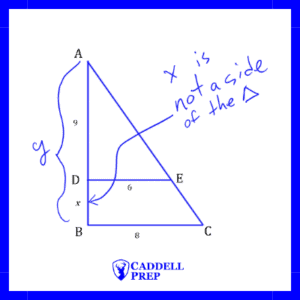
Now, we cans set up the proportion as

cross-multiply to get

divide both sides by 6

Remember than the question is asking for
To find


A proportion can be used for converting measurements.
However, on the Digital SAT, it is common to get a question about converting from one unit of area measurement to another, but the given conversion is for lengths.
For example,
The area of a park is 34.5 square miles. What is the area of the park in square feet? (1 mile = 5,280 feet)
A common mistake is to set up the proportion like this:

The units don’t match up.
The ratio of lengths has to be converted to a ratio for areas. All you have to do is square the ratio.
(1 mile = 5,280 feet)
becomes
(1 square mile = 27,878,400 square feet)
The correct ratio is:

Cross multiple to get


Three common mistakes students make when answering ratios & proportions questions are filling in the proportion incorrectly, solving for
A common mistake for ratios & proportions questions is filling in the values into the proportion incorrectly. I recommend writing down how you will set up the proportion before creating the proportion. For example, write 
A common mistake for ratios & proportions questions that involve a total is solving for
For example, if the total number of books on a shelf is 25 and the ratio of fiction to nonfiction books is 4:1, then you can solve for the number of each type of book.
Set up your equation:
(# of fiction books) + (# of nonfiction books) =25

Combine like-terms

Divide both sides by 5

If the question asked for the number of fiction books, 5 would be the wrong answer because the number of fiction books is 
You have to substitute 5 in for
# of fiction books =

A common mistake in ratios & proportions questions is using the conversion of lengths as the conversion of area. To get the conversion for areas, you have to square both terms in the conversion of lengths. If you think about it, it makes sense because lengths use regular units and areas use units squared.
For example,
1 

therefore
1 

You can use a proportion for finding missing sides in a triangle if you have two similar triangles. It’s important to know that two triangles are similar if two pairs of angles are congruent.
Then you can make a proportion using sides you know and the missing side.
I recommend writing down how you will set up the proportion.
For example, I would write:

Make sure you match up corresponding sides in the proportion, such as the biggest side of the big triangle is matched with the biggest side of the small triangle.
You can find an equivalent area in different units if you are given the conversion for lengths by squaring the values in the conversion.
For example, if you are given that
1 
Square both values and units to get
1 
Yes, if your proportion is set up with only one variable, then you can use Desmos to solve it without cross-multiplying. Make sure to use