
Home » The Digital SAT: What’s Tested, How It’s Scored, and How to Improve Your Score » The 15 Digital SAT Reading & Writing Topics: How Often Each Is Tested and the Order They Appear » SAT Grammar Rules: Every Rule Tested on the Digital SAT
By Glyn Caddell, BSME · Author of Digital SAT Math Secrets · Tutoring since 2008 — Published August 27, 2026
Grammar is approximately 25% of the Reading & Writing section, and it’s the only part of that section that works on rules. Every other topic requires judgment. Grammar questions have a right answer that follows from a rule, and once you know the rule you get the question right every time.
That makes grammar the fastest part of the Digital SAT to improve. If you need to improve fast because time is limited, focus specifically on punctuation and verb tense. While grammar is 25% of the Reading & Writing section, the specific grammar topics punctuation and verb tense make up about 21.8% of the section.
Most guides list the grammar rules in no particular order, and some of them still include rules that were removed when the SAT went digital. This page covers every rule that’s actually tested, in order of how often the topic appears, along with the rules that no longer show up.
What Grammar Rules Are Tested on the Digital SAT?
We categorized every question on the ten full-length practice tests released by the College Board. Grammar questions fall into four topics.
- Punctuation — commas, semicolons, colons, dashes, and apostrophes. 13.6% of the Reading & Writing section.
- Verb tense and subject-verb agreement — 8.2%
- Pronouns — 1.7%
- Modifiers — 1.5%
Together that’s 25% of the section.
Punctuation on its own is more than the other three combined. It works out to about one question in seven on the entire Reading & Writing section, which makes it the single most valuable thing to study in this part of the test.
SAT Grammar Cheat Sheet
Here’s every rule in one place. The percentages are for the topic, not the individual rule, for a reason explained in the next section.
Punctuation — 13.6% of the section
| Rule | Remember… |
|---|---|
| Comma | Separates non-essential information |
| Semicolon | Joins two complete sentences |
| Colon | Introduces an explanation or a list |
| Dash | Sets off an interruption |
| Apostrophe | Possession or contraction |
Verbs — 8.2% of the section
| Rule | Remember… |
|---|---|
| Verb tense | Keep it consistent unless the time period shifts |
| Subject-verb agreement | Ignore the words between the subject and the verb |
Pronouns — 1.7% of the section
| Rule | Remember… |
|---|---|
| Its vs. it’s | It’s = it is |
| Who vs. whom | After a preposition, use whom |
| Antecedents | Every pronoun needs a clear noun that it replaces |
Modifiers — 1.5% of the section
| Rule | Remember… |
|---|---|
| Placement | A modifier must sit next to what it modifies |
| Introductory phrases | Describe the noun right after the comma |
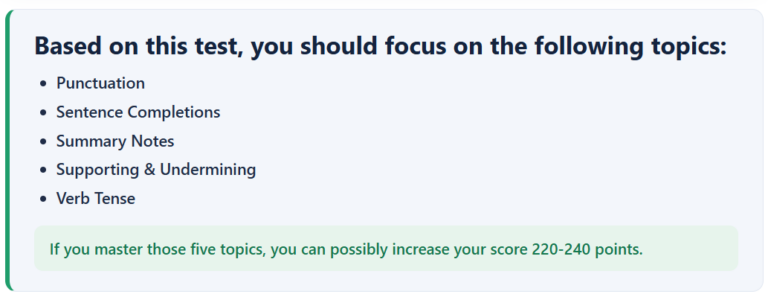
Want to Know What 5 Topics Will Improve Your SAT Score the Most?
Sample Feedback from our Diagnostic Test:
Why You Can't Study Punctuation One Rule at a Time
We don’t publish a percentage for each individual punctuation rule, and there’s a reason for that.
A punctuation question doesn’t ask whether a semicolon is used correctly. It gives you four versions of the same sentence, and the only thing that changes between them is the punctuation.
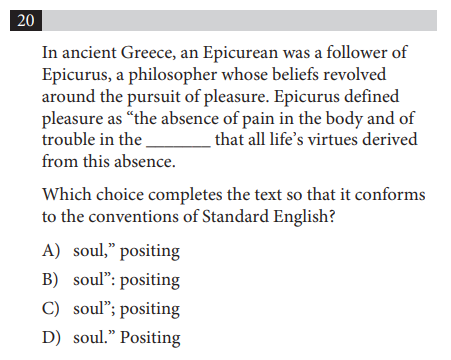
To answer that question you have to know why three of those choices are wrong, not just why one is right. A student who has learned semicolons but not colons can eliminate one option and then guesses between the rest.
That’s why punctuation is worth studying as a group rather than one mark at a time, and it’s why it deserves the largest block of your study time. It’s 13.6% of the section, and the questions pull from all of it at once.
See the full punctuation lesson with practice questions and video explanations
Punctuation Rules (13.6% of the Section)
Five marks, and the test uses each of them in a small number of predictable ways.
When to Use a Comma
A comma separates information that isn’t essential to the sentence. If you can remove the phrase and the sentence still makes sense, it gets commas around it.
Error: The daisy a perennial plant sometimes known as bruisewort grows low to the ground. Fix: The daisy, a perennial plant sometimes known as bruisewort, grows low to the ground.
Error: US President, Barack Obama, will meet with leaders from several European countries. Fix: US President Barack Obama will meet with leaders from several European countries. (The name is essential to the sentence, so it doesn’t get commas.)
When to Use a Semicolon
A semicolon joins two complete sentences. If what’s on both sides of it could stand alone, a semicolon works. Do not use a conjunction after it.
Error: The architect worked on the model all night, he was tired during the presentation. Fix: The architect worked on the model all night; he was tired during the presentation.
Error: I don’t like pepperoni pizza; but it was the only option available. Fix: I don’t like pepperoni pizza, but it was the only option available. (There’s a conjunction, so it takes a comma instead.)
When to Use a Colon
A colon introduces an explanation, a definition, or a list. What comes before the colon has to be a complete sentence.
Error: It’s easy to explain why seniors start taking school less seriously in the spring; senioritis. Fix: It’s easy to explain why seniors start taking school less seriously in the spring: senioritis.
Error: The kitchen techniques I learned were, knife skills, timing, and cooking several dishes at once. Fix: The kitchen techniques I learned were the following: knife skills, timing, and cooking several dishes at once.
When to Use a Dash
A dash sets off an interruption. It works like a pair of parentheses, and if the interrupting phrase is in the middle of the sentence, you need a dash on both sides.
Error: The stylist picked up the scissors—the kind that sit in blue liquid, and started cutting. Fix: The stylist picked up the scissors—the kind that sit in blue liquid—and started cutting.
Error: After readers found the errors, all 243 of them—the publisher issued a reprint. Fix: After readers found the errors—all 243 of them—the publisher issued a reprint.
Apostrophes: Possession and Contraction
An apostrophe does two jobs. It shows that something belongs to something else, and it stands in for missing letters in a contraction.
For a singular noun, add apostrophe + s. For a plural noun that already ends in s, add just the apostrophe.
Error: Every morning, many hawk’s circled the field. Fix: Every morning, many hawks circled the field. (Plural, not possessive.)
Error: The classroom that belongs to three students is the students classroom. Fix: The classroom that belongs to three students is the students’ classroom.
Fragments and Run-Ons
A sentence needs a subject and a verb, and it can’t start with a word like because or when unless it’s attached to a complete sentence.
A run-on is two complete sentences joined by nothing, or by only a comma. Fix it with a period, a semicolon, a comma plus a conjunction, or by making one of them dependent.
Error: For the sake of a better experience at school, asking his adviser for a new room assignment. Fix: For the sake of a better experience at school, the freshman asked his adviser for a new room assignment.
Error: The deli had no milk left after the morning rush, the owner ordered more. Fix: Because the deli had no milk left after the morning rush, the owner ordered more.
Finally, an SAT course that students actually understand
Every question has a video explanation. Not most — every one.
The on-demand Digital SAT course covers all 17 math topics and 15 reading and writing topics, with 5 full-length practice tests and a 100-point score increase guarantee. Keep access for the rest of high school. No subscription.
Verb Rules (8.2% of the Section)
Two things get tested. Whether the tense is consistent, and whether the verb matches its subject.
Keep Verb Tense Consistent
Verbs in a sentence should stay in the same time period unless something in the sentence signals a shift.
Error: Last week, Frank rented a car and drives to Boston. Fix: Last week, Frank rented a car and drove to Boston.
Error: Even though office hours had been over for some time, the professor and her student are still working. Fix: Even though office hours have been over for some time, the professor and her student are still working.
Match the Verb to the Subject
A singular subject takes a verb that ends in s. A plural subject takes a verb that doesn’t.
Error: A crowd of people keep getting in the way. Fix: A crowd of people keeps getting in the way. (The subject is “crowd,” which is singular.)
Error: The furniture in most people’s homes are made of wood. Fix: The furniture in most people’s homes is made of wood.
Ignore the Words After "Of"
That last example points to the trick the test uses most often. It puts words between the subject and the verb so that the wrong one looks like the subject.
When you see a phrase like one of the students or a crowd of people, the subject is the noun before the “of.” Ignore everything after it.
Error: One of the students want to study after school. Fix: One of the students wants to study after school. (The subject is “one,” not “students.”)
The same applies to other prepositions, like in, with, and along with. “Of” is just the most common one on the test.
Pronoun Rules (1.7% of the Section)
Pronouns are a small topic, which means they’re fast to close. There are only a handful of rules and the questions are straightforward once you know them.
Its vs. It's
It’s is the contraction of it is or it has. Its shows possession. If you can substitute “it is” and the sentence works, use the apostrophe.
Error: The painting became famous for it’s unusual half-smile. Fix: The painting became famous for its unusual half-smile.
Their, There, and They're
Their shows possession. They’re is the contraction of they are. There refers to a place, or starts a sentence like “there are.”
Error: Maria checks they’re due dates before returning the books. Fix: Maria checks their due dates before returning the books.
Who vs. Whom
After a preposition, use whom, not who. Another test is to substitute he or him. If him works, use whom.
Error: The tax reduction only benefits people whom understand the tax code. Fix: The tax reduction only benefits people who understand the tax code.
Every Pronoun Needs a Clear Antecedent
If it isn’t obvious which noun a pronoun replaces, the sentence needs to be rewritten. The fix is normally to replace the pronoun with the noun.
Error: The files arranged by the temporary workers were out of order, so management sent them back. Fix: The files arranged by the temporary workers were out of order, so management sent the files back. (“Them” could mean the files or the workers.)
Pronouns Must Agree With What They Replace
A singular noun takes a singular pronoun. A plural noun takes a plural pronoun.
Error: After acquiring several companies, the corporation moved their headquarters. Fix: After acquiring several companies, the corporation moved its headquarters.
Modifier Rules (1.5% of the Section)
Almost every modifier question on the test follows the same pattern, which makes this the fastest topic on the page to learn.
Dangling Modifiers
When a sentence starts with a descriptive phrase and a comma, the noun right after the comma has to be the thing that phrase describes.
Error: Coating the sidewalk, we trudged through the heavy snow. Fix: We trudged through the heavy snow coating the sidewalk. (The snow is coating the sidewalk, not us.)
Error: Exhausted and weak, the soldiers’ uniforms were covered in frost. Fix: Exhausted and weak, the soldiers were covered in frost.
Misplaced Modifiers
A modifier has to sit next to what it describes. If it’s somewhere else in the sentence, it looks like it’s describing the wrong thing.
Error: The jacket was too small on the sale rack. Fix: The jacket on the sale rack was too small.
Error: She handed out brownies to children wrapped in foil. Fix: She handed out brownies wrapped in foil to children.
Grammar Rules That Are No Longer Tested
Several SAT grammar guides still list rules that were on the paper SAT and were removed when the test went digital. Studying them won’t hurt you, but it’s time you could spend on the rules that actually appear.
Here’s what’s no longer tested.
Parallel Construction
Parallel construction means that items in a list should share the same grammatical form. If two items in a list are verbs ending in -ing, the third one should be too.
For example:
Not parallel: Painting your bedroom requires picking a color, measuring the walls, and you have to buy paint. Parallel: Painting your bedroom requires picking a color, measuring the walls, and buying paint.
Parallel construction was tested on the paper SAT. It does not appear on the Digital SAT.
Illogical Comparisons
An illogical comparison compares two things that aren’t in the same category. You can compare one person’s apples to another person’s apples, but not to the other person.
For example:
Illogical: Dickens’s novels are more sweeping than Jane Austen. Logical: Dickens’s novels are more sweeping than Jane Austen’s novels.
The second version of this rule involves comparing something to all other things of its type rather than to all things of its type. “The moon is easier to reach than any other object in space,” not “than any object in space.”
Illogical comparisons were tested on the paper SAT. They do not appear on the Digital SAT.
Want to Know What 5 Topics Will Improve Your SAT Score the Most?
Sample Feedback from our Diagnostic Test:
One More Rule-Based Topic: Transitions (9.7% of the Section)
The College Board classifies transitions under Expression of Ideas rather than Standard English Conventions, so technically they aren’t grammar.
However, they behave like grammar. You read two sentences, figure out the relationship between them, and pick the word that matches. That’s a rule you can learn, not a judgment you have to develop.
At 9.7% of the section, transitions come up more often than verb tense does. If you’re working through the rule-based part of Reading & Writing, this belongs on the list.
How to Study SAT Grammar
Four things matter more than how many rules you get through.
1. Start With Punctuation, and Study It as a Group
It’s 13.6% of the section, more than the other three grammar topics combined. And because the questions pull from several rules at once, learning commas without learning semicolons leaves you guessing.
2. Learn One Rule at a Time, Then Practice It
Read the rule, then do questions that test only that rule until you get them right consistently. Moving on before that happens means you’ll have to come back.
3. Grammar Improves Faster Than the Reading Topics
A grammar rule works the moment you learn it. Judgment on a reading question develops over weeks. If you have limited time, grammar is where the points are.
4. Practice in Context
The test never asks you to name a rule. It gives you a sentence with four versions of one part of it, and you pick the version that’s correct. Studying grammar terminology is not the same as being able to answer the question.
Every SAT Grammar Rule, Summarized
Punctuation — 13.6%
- Comma: separates non-essential information
- Semicolon: joins two complete sentences, no conjunction after it
- Colon: introduces an explanation or a list, with a complete sentence before it
- Dash: sets off an interruption, in pairs if it’s mid-sentence
- Apostrophe: possession or contraction
- Fragments and run-ons: every sentence needs a subject and a verb
Verbs — 8.2%
- Verb tense: keep it consistent unless the time period shifts
- Subject-verb agreement: singular subject, singular verb
- Ignore the words after “of” when finding the subject
Pronouns — 1.7%
- Its vs. it’s, their vs. there vs. they’re
- Who vs. whom: after a preposition, use whom
- Every pronoun needs a clear antecedent
- Pronouns agree in number with what they replace
Modifiers — 1.5%
- A modifier sits next to what it modifies
- An introductory phrase describes the noun right after the comma
No Longer Tested
Parallel construction and illogical comparisons are no longer tested on the SAT.
Frequently Asked Questions
Students studying SAT grammar frequently ask how many grammar questions are on the test and which rules matter most.
How many grammar questions are on the Digital SAT?
Grammar is approximately 25% of the Reading & Writing section, based on our analysis of the ten official practice tests. The College Board reports the Standard English Conventions domain at about 26%, which works out to roughly 14 to 16 questions across both modules.
What grammar rules should I memorize for the SAT?
Punctuation first, since it’s 13.6% of the section on its own. Then subject-verb agreement and verb tense at 8.2%, pronouns at 1.7%, and modifiers at 1.5%. All of them are covered on this page.
What's the most commonly tested grammar rule on the SAT?
Punctuation, by a wide margin. It accounts for more grammar questions than verb tense, pronouns, and modifiers combined.
Is parallel structure tested on the SAT?
No. Parallel construction was tested on the paper SAT and was removed when the test went digital. Some guides still include it.
Is grammar the easiest part of the SAT to improve?
For most students, yes. Grammar questions have a right answer that follows from a rule, so once you know the rule you get the question right. The reading topics require judgment, which improves more slowly.
Do I need to know grammar terminology for the SAT?
No. You never have to name a rule or identify a part of speech. You have to recognize which version of a sentence is correct.
Does the Digital SAT test spelling?
No. There are no spelling questions on the Digital SAT.
What's the fastest way to improve my SAT grammar score?
Learn the punctuation rules as a group, then drill punctuation questions until you’re getting them right consistently. It’s 13.6% of the section and the rules are a defined set.
How do I know whether I missed a grammar question or a reading question?
Your score report groups questions by domain. Grammar questions fall under Standard English Conventions. Reading questions fall under Information and Ideas, Craft and Structure, or Expression of Ideas.
Take a Free Diagnostic SAT
The fastest way to find out whether grammar is where your points are is to take a diagnostic test with an assessment. Students can take a free practice SAT with Caddell Prep to get an accurate score based on College Board scoring, along with an assessment showing exactly which topics to study.
If you’d rather work through the material on your own schedule, our on-demand Digital SAT course covers all 15 Reading & Writing topics with a video explanation for every practice question, and it comes with a 100-point score increase guarantee.

Glyn Caddell
Glyn Caddell holds a BS in Mechanical Engineering from NJIT and has been tutoring New York City students since 2008. He founded Caddell Prep in 2012 and is the author of Digital SAT Math Secrets: Lessons & Tricks to Quickly Improve to a Perfect 800 on the Math Test, which contains over 900 practice problems and is used in Caddell Prep’s SAT math classes. He is founding president of the Staten Island Technical High School alumni association and teaches every lesson on this site personally.
Need Help Preparing for the SAT?
Use the only SAT prep course built with an engineer’s approach and taught in a way that students actually understand.
100-point score increase guarantee
Take a Free Diagnostic SAT
Discover the 5 Topics That Could Make the Biggest Difference in Your Score.
Take our free diagnostic and receive a personalized assessment showing exactly what to study next.